LONG READ
It can feel sometimes that our modern world is becoming more and more divided and disconnected. Battle lines are drawn across clashing beliefs. Politicians and demagogues seem to be taking advantage of our growing distrust and anxiety to stoke up even more conflict. How did this happen? Researching the mental health legacy of Covid for her previous article, cross-cultural advocate and author Yang-May Ooi, came across Naomi Klein’s fascinating and powerful book Doppelganger. In her book, Klein explores the fragmentation of the Anglosphere psyche during the fear, uncertainty and doubt of Covid and its chilling aftermath for our societies today.
Naomi and Naomi
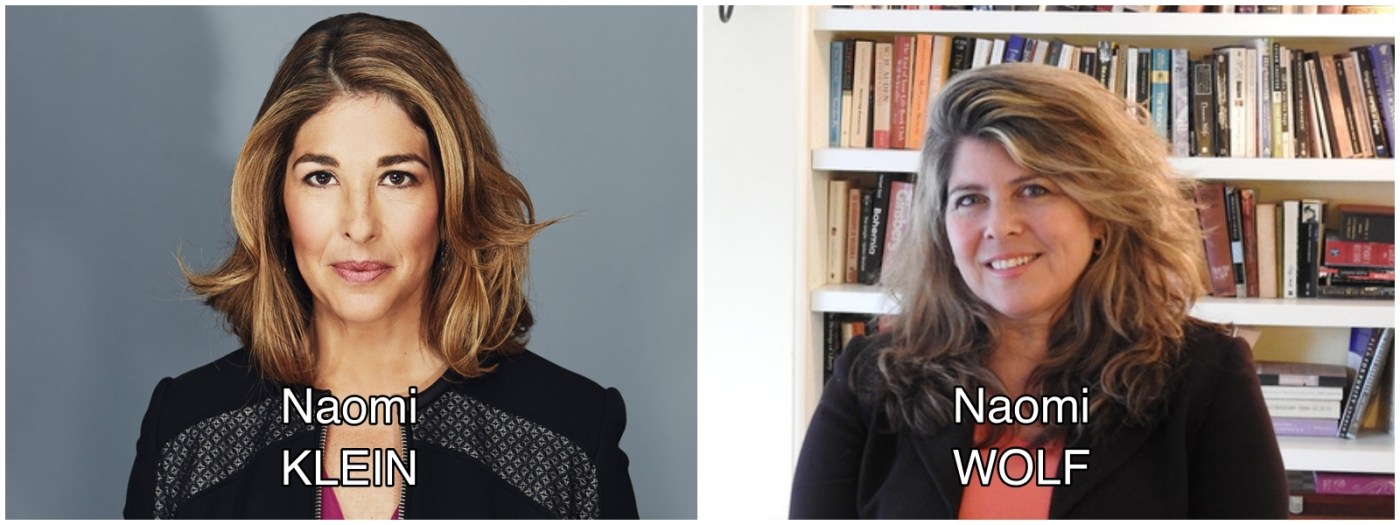
Naomi KLEIN is a journalist and best-selling author of No Logo and other books about corporate greed and the climate crisis. She is a professor at the University of British Columbia and co-director of The Centre for Climate Justice.
Her book Doppelganger, tells the story of how her identity became confused and even conflated with the identity of another well-known author Naomi WOLF who wrote The Beauty Myth. As Klein explains, this could have happened because the two women are both called Naomi and they are both Jewish, high-profile authors, with big dark hair. Their one word surnames could be perhaps easily overlooked or misread especially by people scanning online text. At one time, they were well-regarded feminist liberal public intellectuals who would have shared similar views against economic and social injustice especially as embodied in male-dominated multinationals and authoritarian regimes that exploit the poor, lie and cheat and indulge in corrupt practices. So for casual readers or the average person, it might be easy to remember only “Naomi” and the general arena they both occupied.
.

.
However, as Klein writes, Wolf went down the rabbit hole of conspiracy theories and emerged the other side as an anti-vaxxer, a protogee of Steve Bannon (one-time Trump adviser and far-right marketing supremo), supporter of right-wing ideology and propagator of all manner of conspiracy theories. She was banned from Twitter for spreading misinformation – until Elon Musk took over Twitter and reinstated numerous banned accounts. Wolf became the laughing stock of the mainstream and there were many articles and online discussions expressing the bewilderment from those who once respected her and her thinking – eg. The Madness of Naomi Wolf and What happened to Naomi Wolf?
Klein vs Wolf
The existing confusion about the two authors became more entrenched as many on social media and even some traditional media began attributing Wolf’s writing and ideas to Klein. Klein found herself trolled, criticised and accused of spreading fake news by people who were mistaking her from her Doppelganger, Wolf. After a period of frustration, her worry grew about the damage this was doing to her reputation as an evidence-based, meticulously-researching, fact-checking journalist, writer and professor.
Klein became obsessed with Wolf and her right-wing opinions and unfounded theories that seemed to be garnering enthusiastic and adoring followers. How did Wolf get sucked into this “mirror world”, as Klein calls it, where fake news peddlers accuse fact-based journalism as fake news and pseudo-science is replacing actual evidence-based science as truth? How did this Yale-educated, Oxford University Rhodes scholar with a Ph.D become a fake news, pseudo-science, conspiracy champion herself? How could so many intelligent, caring people split off into an ever-growing tribe of misinformation evangelists who rage against people they love and the world of checks and measures that we all rely on?
Klein decided to follow Wolf’s trajectory and investigate how Wolf and her followers came to believe unshakeably in conspiracy theories – and how their rage against the established order of the world is increasingly destabilising and destructive to the Anglo world of America and Britain today.
In Klein’s investigation, it looks like it all began with Covid….
.
.
A detective story blended with fact-checked journalism
Klein uses the personal story of her quest to understand Wolf as the way in to understanding the people drawn in to the “mirror world” of conspiracy theories and pseudo-science. The personal voice and storytelling is interwoven with research, investigative journalism and fact-checking. It is a terrific read and while the story grips us like a detective novel might, we also learn a lot about psychology, society, politics and history in an easily digestible way.
There is so much in the book that I may risk retelling it all here much less powerfully than Klein’s own narrative. I will restrict myself to a few key insights that are specific to my exploration of Belonging.
Most of us retain a trust in the institutions of our Western democracies – the government, the medical profession, the scientific community, the legal system and law enforcement – despite occasionally learning about corrupt practices and the human failings of the individuals within these institutions. However, there are those of us who have no reason to trust them – and perhaps even have every reason to distrust them: those who feel overlooked politically, left behind economically, exploited not just financially but bodily, and more. Those of us who feel they do not belong to the world the rest of us comfortably belong to. Lockdown, vaccinations, mask-wearing, social distancing, job insecurity and all the unnerving strangeness of the Covid years amplified their distrust and suspicion of “the powers that be” – and increase their sense of un-belonging.
Also, while most of us cherish the individualism afforded to us by our liberal democracies, we understood the need to make certain sacrifices for the greater good – like getting vaccinated, wearing masks, distancing socially and so on. For those of us whose individual identities might be feeling already threatened or who have taken capitalist individualism to an extreme of self-regard, these health measures felt like an invasion of the self tantamount to bondage or an attack on their personal liberty. These are the ones of us who fear that belonging to the greater society means a destruction of self and personal liberty.
An evil mastermind?
Medical scientists were often one step behind the virus in the early days – like the detective always just catching up to their cunning, shape-shifting serial killer – for the reason that the disease was spreading so fast and it takes time to research it and to create and test antidotes. The science then had to be communicated to political leaders and medical teams on the ground. National responses across the world were varied and uncertain.
In the vacuum, people took to online platforms to research, talk, exchange ideas and worries. Rumours and gossip proliferated. Self-styled leaders and gurus gave pronouncements about cures, speculated about dark forces behind the chaos. It can be easier and perhaps even comforting to find an evil mastermind behind happenings we do not understand than to realise that no-one knows how it all started, why it’s happening and what to do about it. It can give us a sense of belonging to be amongst people so confident in their special knowledge. So Bill Gates, among other singular rich and powerful people, was blamed for a dark plot to control the world.
.

.
But wait, is there not good reason for us to distrust our governments and the wealthy elite? Before Covid… Remember the rescue payouts to corporations and banks while most of us who default on our loans are left to go bankrupt? Remember the lies about the NHS in the lead up to the Brexit vote? Klein cites many more examples and I am sure you can think of your own. These things have been undermining trust in our governments and systems for a long time.
So for those of us who distrust the established world that was fortified by such past scandals was strengthened by what was happening during Covid. It made sense to follow these others like themselves than those traditionally in power. When the science caught up and policies began to change, it was possibly too little too late – the mindset had crystallised and the reinforcement of others all who believed the same way made that way of thinking all the more legitimate and powerful.
Families, friends and co-workers found ourselves sometimes on opposite sides of the trust debate. Arguments about masks and jabs could become heated and ferocious. Perhaps we also found a sense of comfort in belonging to the “right” side of the argument, as we each saw it. But at the heart of it, each “side” believed we were doing what was best for our own health and the health of our loved ones. But if we got it wrong, we might have to pay the highest consequence: death. And so we fought like it was a matter of life and death – because, potentially, it was.
But don’t feel smug
But Klein does not want us who were the conscientious “good folk” to feel smug. We who followed the guidelines and did our bit by getting our vaccinations and wearing masks. We who helped create “herd immunity” – were we an unquestioning herd that gave away our power? She ask: what more could we have done before Covid and also during – and now in its aftermath?
Before Covid, what more could have been done to prevent the financial spinning that led to the 2008 financial crisis? What could have been learnt from it give more economic power to ordinary individuals vs big financial institutions?
Could we have done more to call our leaders into account during Covid? The UK failed PPP contracts that were carelessly given out by the government come to mind.
What about paying health workers better wages? It’s all well and good clapping for them from our doorsteps but what about actual real rewards like better take home pay?
I am sure you can think of other examples too.
We have the power to call our leaders and institutions to account – but did we? Do we now?
Klein also looks at the capitalist and individualistic advantage of division and those who have most to gain politically from people taking sides. This part of Doppelganger is a wake-up call to all of us who feel passionate about various of today’s hot-button issues. Are we being played? Who is to profit from our splintering into this faction and that? What political or economic issues are we being distracted from while we shout and protest about this big issue or that one? Whose ego will be rewarded for entering the fray as a leader?
Some scepticism about our leaders and institutions is certainly necessary. The system we live in is not perfect and we should and must question and hold them to account. And perhaps the more we do that, the more trust in them can be eventually regained.
The Divisive Legacy of Covid
I would urge you to read Doppelganger. Klein raises thought-provoking questions while she takes us on an eye-opening journey into the “mirror world”. She also requires us to look at ourselves. She approaches the stories and people who are diametrically opposed to her own perspectives and beliefs with compassion and curiosity. She invites us to understand and empathise rather than judge and despise. Because in looking at them in the “mirror” we are also looking at us.
It is a truly important book and her call to understand those on the other side of the mirror to our worldview is much needed. It seems to me that the distrust and division that took hold with Covid conspiracies and the splintering into disparate tribes has now become a way of thinking that continues to fragment society into opposing tribes. The danger in tribes is that while we may feel a strength and certainty in belonging to one tribe or another, that way of thinking pits us against those we consider not in our tribe.
It seems to me that these days, clickbaiting, deep fake images and videos, and inflammatory posting on social media are stirring outrage beyond the issues that Covid laid before us. We are all ready to rise up over all manner of hair-trigger issues. Some stories and statements we see online may be true, some not. Doppelganger prompts us to reflect before we believe what we read, to ask if this simply reinforces our anger, and who or what our outrage serves – and whether we are being manipulated and why, and to what end. And what we can do that comes from a place of common humanity rather than knee-jerk fear or anger.
READ Doppelganger by Naomi Klein – via Amazon or all good bookshops
.
—
Photos:
Naomi Klein – https://www.arts.ubc.ca/news/naomi-klein-on-the-future-of-climate-justice/
Evil mastermind – https://pixabay.com/photos/alien-reptilian-portrait-politician-560710/
Subscribe
Subscribe to the convenient monthly newsletter for the latest stories and insights from Belonging Across Cultures and my other creative work. It’s free and will wing its way into your Inbox no more than once a month.
Subscribers will also receive exclusive “goodies” from time to time – like Yang-May’s personal Eat Like a Local Guide to Kuala Lumpur, Singapore and London.

About
Yang-May Ooi is a cross-cultural advocate and author. Her creative work includes novels The Flame Tree and Mindgame and a family memoir & theatre performance Bound Feet Blues. She is also the creator of the podcasts Creative Conversations, The Anxiety Advantage and MetroWild.
Find out more at www.TigerSpirit.co.uk. You can also connect with Yang-May on social media – @TigerSpiritUK.
Belonging Across Cultures aims to bring people together across cultural and social divides through personal stories. We celebrate Belonging through the different lenses of Food, Music, Landscape and more. Join other curious minds and subscribe to my newsletter here.

Leave a comment